
Loading...
Loading...

San Phra Phum · ศาลพระภูมิ
Every building in Thailand has a guardian. The spirit house is not decorative — it is the home of the spirit of the land.
The spirit house — a miniature temple on a pedestal — is installed when a building is constructed. It is the home of the Phra Phum: the guardian spirit of the land. Without it, the displaced spirit would cause misfortune to the residents.
This belief crosses class, region, and even religion. The spirit house outside the Bangkok InterContinental is maintained as carefully as the one outside a family home in Isan. It is not a rural or folk tradition — it is a universal Thai practice.
San Phra Phum
Spirit of the Land
Red Fanta
Said to be preferred over plain water; the colour brings prosperity and is visually festive.
Incense Sticks
Three sticks minimum — these connect the physical world to the spirit realm through smoke.
Fresh Flower Garlands
Jasmine and marigold garlands, replaced regularly as they wilt.
Miniature Elephants
Symbols of power and protection; they invite the spirit's strength to guard the property.
Fruit & Sweets
Bananas, oranges, and wrapped sweets — fresh only, never rotting.
Maintain it. Let offerings dry out and replace them regularly. Moving or removing a spirit house without performing a proper religious ceremony is considered genuinely dangerous by most Thai landlords and neighbours — not metaphorically, but literally. Most rental contracts implicitly include this expectation.
Walk almost anywhere in Thailand and you'll begin to notice them.
Outside luxury hotels, beside family homes, in the corner of shopping centres, outside hospitals, factories, office blocks, restaurants, petrol stations and even construction sites, you'll see beautifully decorated miniature buildings standing on raised pillars.
Some are simple wooden shrines. Others are elaborate structures finished in gold, decorated with mirrors, tiny staircases and carved figures.
Fresh flowers may be hanging from them. Incense sticks may still be burning. Small cups of water sit neatly arranged beside colourful bottles of bright red soft drink. Tiny elephants, dancers, animals and miniature people often stand around them as though a small community exists within their boundaries.
To many visitors they look decorative. Some assume they are simply garden ornaments. Others believe they are tiny Buddhist temples.
Neither explanation is quite right.
These are known as Spirit Houses, and understanding them provides one of the clearest windows into how Thai culture has developed over hundreds of years.
A Spirit House is traditionally built to provide a respectful home for the guardian spirit believed to protect the land on which a property stands.
Rather than allowing that spirit to wander or become unsettled when land is developed, a separate dwelling is prepared nearby where offerings can continue to be made.
The belief is based on showing respect rather than fear.
By providing the guardian spirit with its own place to reside, harmony is maintained between the people living or working on the land and the unseen spiritual world that many Thais acknowledge as part of everyday life.
This is why Spirit Houses are almost always positioned outside the main building rather than inside it.
The house belongs to the spirit.
The building belongs to the people.
Both exist alongside one another.
One of the biggest misunderstandings visitors make is assuming Spirit Houses are purely Buddhist.
In reality, their origins are much older.
Long before Buddhism arrived in what is now Thailand, people throughout Southeast Asia believed that forests, rivers, mountains and land itself were occupied by protective spirits.
These early animist beliefs recognised that humans shared the world with unseen beings deserving of respect.
When Buddhism later spread throughout the region, it did not replace these traditions completely. Instead, many of the older beliefs continued alongside Buddhist teachings.
Over centuries they became woven together into everyday Thai life.
This is why a Thai family may visit a Buddhist temple in the morning, make merit for deceased relatives and later place fresh flowers or food at their Spirit House without seeing any contradiction.
To most Thai people these practices simply belong together. One reflects religious teaching. The other reflects respect for the unseen guardians believed to occupy the land.
For many Western visitors, religion is often viewed as something that must fit neatly into one belief system.
Thailand approaches spirituality rather differently.
It is perfectly normal for someone to do all of these things without seeing any contradiction:
These traditions have developed alongside one another for centuries.
Rather than competing, they often complement different parts of daily life.
Understanding this helps explain many customs that otherwise seem confusing to newcomers.
Another common misconception is that Spirit Houses are built because people believe ghosts live inside them.
That is a considerable oversimplification.
Traditional belief speaks more about guardian spirits connected with the land itself rather than frightening supernatural figures portrayed in films.
These spirits are generally regarded as protectors rather than something to fear. Providing them with respect through a suitable dwelling and occasional offerings is seen as a way of maintaining harmony rather than avoiding punishment.
Like many traditional beliefs throughout the world, interpretations vary between families. Some people hold these beliefs very strongly. Others regard them as cultural tradition. Many simply continue practices handed down through generations because that is how their parents and grandparents lived.
Whether someone believes literally in guardian spirits is almost secondary.
Spirit Houses continue to matter because they represent respect.
Respect for the land. Respect for those who came before. Respect for tradition. Respect for living alongside something larger than ourselves.
That is one reason you will find Spirit Houses outside billion-pound hotels just as often as outside a small family home in rural Thailand.
They quietly remind people that progress and modern life do not necessarily replace older traditions. Sometimes they simply grow alongside them.
Once you begin looking for Spirit Houses, they seem to appear almost everywhere.
Outside family homes. Luxury hotels. Apartment buildings. Shopping centres. Banks. Factories. Office towers. Hospitals. Schools. Restaurants. Petrol stations. Construction sites. Even some international companies operating in Thailand choose to install one.
To many visitors this comes as a surprise. Surely large multinational businesses don't really believe in guardian spirits?
The answer is usually more complicated than a simple yes or no.
For many organisations, installing a Spirit House is less about proving belief and more about showing respect for Thai culture, employees, local traditions and the community around them. Whether viewed spiritually or culturally, the ceremony is seen as an appropriate way to begin life on newly developed land.
Unlike garden ornaments, a Spirit House is not placed wherever it happens to look attractive. Its position is considered carefully.
Traditional practitioners believe the house should stand where it receives good fortune and does not fall beneath the shadow of the main building for significant parts of the day.
The exact placement may also consider:
The aim is to provide a suitable place where the guardian spirit may reside peacefully without conflict with the activities of those occupying the building. Although practices vary across Thailand, thoughtful positioning is considered an important part of the installation.
A Spirit House is rarely placed in position casually.
Its installation is usually marked by a formal ceremony attended by family members, business owners or employees.
Offerings may include flowers, incense, candles, fruit and symbolic foods. Traditional prayers are performed before the house becomes its permanent home.
For private houses this can be an intimate family occasion. For hotels, factories or office developments it may involve dozens of people gathered together before the business officially begins operating.
It marks the beginning of a new relationship between the occupants of the land and its guardian spirit.
Many visitors are surprised to learn that Buddhist monks are not always responsible for installing Spirit Houses. Ceremonies are often led by Brahmins or specialists trained in traditional rituals and astrology.
These practitioners may advise on:
This reflects Thailand's unique combination of Buddhist belief alongside older Hindu and animist traditions. Each contributes something different to the ceremony.
Although monks may not always install the Spirit House itself, they are frequently invited to bless new homes, businesses or buildings.
It is common for monks to chant, sprinkle holy water and offer blessings before people move into a property or begin trading.
For many families these ceremonies are as much about bringing everyone together as they are about religion.
Neighbours gather. Relatives attend. Food is shared. Children run around while adults prepare offerings. The event becomes both a celebration and a moment of gratitude.
Buying a home is one of life's biggest milestones.
In Thailand it is often marked with ceremonies asking for health, prosperity and happiness for everyone who will live there.
Business owners often do something similar. Before opening a new restaurant, hotel, shop or office, blessings may be held asking for success and protection.
Visitors sometimes mistake these events as superstition. For the families involved, they are simply another way of beginning an important chapter with optimism, gratitude and respect.
Thailand is one of Asia's most modern economies. Its cities are filled with skyscrapers, electric railways, international banks, luxury shopping centres and global businesses.
Yet among all this modern development, Spirit Houses remain remarkably common.
Developers still include them. Hotels still care for them. Families still decorate them. Office staff still leave fresh offerings before important occasions. Construction workers still pause while installation ceremonies take place.
Modern technology changes how people live. It doesn't always change the traditions that help people feel connected to their families, communities and history. Spirit Houses remain part of that connection, quietly standing outside old wooden homes and glass office towers alike.
One of the easiest ways to tell whether a Spirit House is actively cared for is to look at what surrounds it.
Fresh flowers may have been placed there that morning. A small cup of clean water may sit beside incense that has only recently burned. Fruit may be neatly arranged on a plate. Bright red bottles of soft drink often stand in pairs.
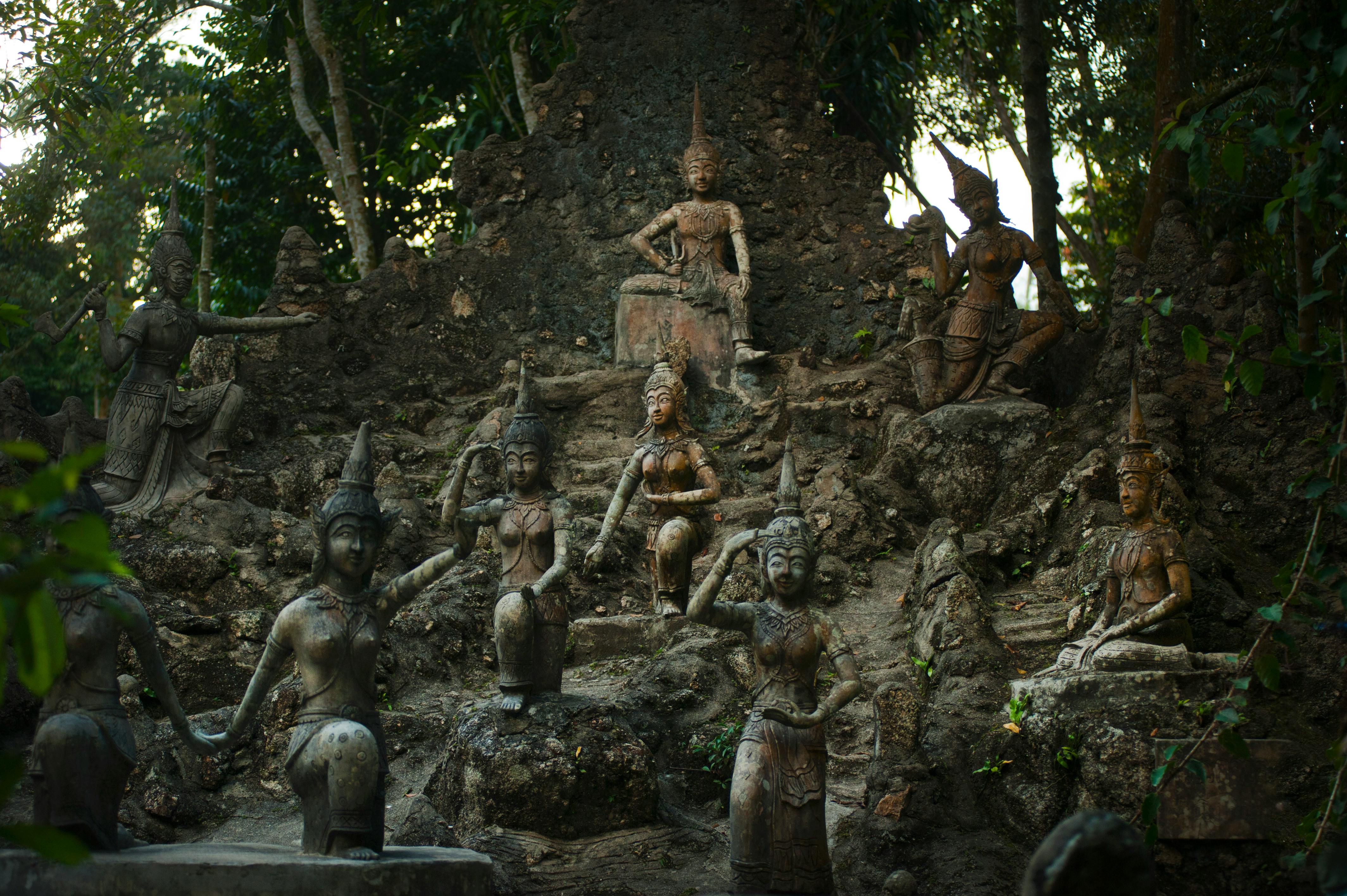
Tiny elephants, horses, dancers and musicians may surround the house, creating what looks almost like a miniature village.
To a first-time visitor it can seem unusual. Why would anyone place a bottle of strawberry-flavoured fizzy drink beside a beautifully crafted shrine?
The answer lies in tradition rather than strict religious teaching.
Offerings are not viewed as payments made in exchange for good luck. They are gestures of respect.
Just as people place flowers on a grave or light candles in places of worship throughout the world, offerings at a Spirit House acknowledge the presence of the guardian spirit connected with the land.
Different families develop their own routines. Some make offerings every morning. Others only on important occasions. Many people leave fresh flowers before travelling, beginning a new business venture or celebrating a family milestone.
The intention matters more than the value of the offering. A simple glass of water given respectfully carries just as much meaning as something more elaborate.
One of the questions visitors ask most often concerns the bright red bottles frequently seen at Spirit Houses.
The explanation is not completely straightforward because traditions vary across Thailand.
One widely accepted explanation is that the colour red has long been associated with vitality, prosperity and life.
Before commercially produced soft drinks became common, coloured sweet drinks were often prepared specially for ceremonial use. As bottled soft drinks became widely available, they gradually replaced homemade drinks in many places.
Today, bright red soft drinks have become one of the most recognisable offerings seen throughout the country. It is one of those traditions that continues because it has become familiar across generations rather than because of any official religious rule.
Fresh flowers symbolise beauty, respect and impermanence. Their short life quietly reflects one of Buddhism's central observations — that everything changes.
Incense is used throughout much of Asia during religious ceremonies. Its fragrance, rising smoke and slow burning remind people to approach sacred places calmly and respectfully.
Water is perhaps the simplest offering of all. It represents purity, refreshment and care. Because water is essential for all living things, offering clean drinking water remains one of the most common acts of generosity.
None of these items are expensive. That is partly the point. Respect is measured by sincerity rather than cost.
Look closely around many Spirit Houses and you may notice entire miniature communities.
Tiny elephants. Birds. Horse riders. Traditional dancers. Musicians. Servants. Animals. Sometimes even small cars or modern figurines appear alongside more traditional statues.
These are not toys. They are symbolic companions placed to create a welcoming environment for the guardian spirit. Their exact meaning varies from one family to another. Some have been inherited over generations. Others have been added gradually as offerings after important events.
Together they create an impression that the Spirit House is an occupied home rather than an empty ornament.
Visitors sometimes wonder what happens to the food after it has been offered.
Fresh offerings are generally removed once they are no longer suitable. Flowers naturally wilt. Fruit eventually spoils. Water is replaced. Food is removed before it deteriorates.
The purpose was never to leave permanent displays. The act of preparing and presenting the offering is itself an expression of respect. Maintaining the Spirit House becomes an ongoing relationship rather than a one-time event.
There is no universal rule followed by every household in Thailand.
Some families make offerings daily. Others only during important festivals. Some maintain beautifully decorated Spirit Houses all year. Others leave them largely untouched except during family ceremonies.
Tradition survives not because everyone thinks identically, but because customs continue to hold meaning in different ways for different people.
Many visitors only notice Spirit Houses when they first arrive. After a few weeks they almost disappear into the background.
Someone may briefly pause before opening their shop. An elderly neighbour may quietly replace flowers before sunrise. A hotel gardener may clean the area each morning before guests wake.
These small acts rarely attract attention. They are simply woven into ordinary life. That quiet consistency perhaps explains why Spirit Houses remain such an enduring part of Thailand's landscape.
Unlike museums or historical monuments, Spirit Houses are living parts of everyday Thai life.
They continue to receive offerings. Ceremonies continue to take place around them. People pause before them on their way to work. Families gather beside them during important occasions.
Treating them respectfully requires very little effort. A little awareness goes a long way.
Unless specifically invited by the owner or someone conducting a ceremony, avoid touching the structure or the figures surrounding it. For many people it is considered a sacred place rather than a decorative object.
Food, flowers, drinks and incense have been placed there intentionally. Even if something appears old or unusual, avoid moving it or picking it up. The offering belongs to the ceremony, not to curious visitors.
Photography is usually acceptable. Avoid climbing onto surrounding structures, leaning against the Spirit House or moving offerings to improve your composition. If someone is actively praying, wait quietly until they have finished before taking photographs.
Some Spirit Houses are positioned close to entrances, pathways or working areas. Avoid blocking access while taking pictures. If a ceremony is taking place, remain to one side unless invited closer.
A beautifully decorated miniature building can easily look like a doll's house. Parents can help simply by explaining that it is an important place for many Thai families. Encouraging children to look rather than touch usually avoids any awkward situations.
If you stay in a hotel in Thailand, there is a good chance a Spirit House stands somewhere near the entrance. Simply avoid treating it as a decorative backdrop for playful photographs or social media content. Staff usually notice it every day.
Visitors sometimes become anxious about accidentally causing offence. In reality, most situations are very simple.
Be respectful. Avoid touching sacred objects. Observe what local people are doing. Keep your voice low if someone is praying. Give ceremonies space.
If you are unsure about something, ask politely. Thai people generally appreciate genuine curiosity far more than confident assumptions. A respectful question is almost always welcomed.
Understanding Spirit Houses does not require you to accept every belief associated with them. People arrive in Thailand from many cultures and many religions. Some have no religious beliefs at all. None of that prevents someone from behaving respectfully.
Respect is not agreement. It is recognising that a place carries meaning for someone else. That small distinction makes travelling through another culture far richer and far more rewarding.
Few parts of Thai culture are misunderstood as often as Spirit Houses.
Visitors usually recognise that they are important, but many assumptions are based on photographs, social media or quick explanations that leave out much of the story.
Understanding what Spirit Houses are not is often just as useful as understanding what they are.
Not exactly. The Spirit House itself is not the object of worship. It is regarded as a dwelling prepared for the guardian spirit connected with the land. The respect shown is directed towards that spirit rather than the structure itself.
Thailand is home to almost seventy million people. Like every country, beliefs differ from one family to another. Some believe very strongly in guardian spirits. Others see Spirit Houses as family tradition. There is no single opinion shared by everyone.
Spirit Houses are rooted primarily in older animist beliefs that existed long before Buddhism reached Thailand. Over centuries those traditions became intertwined with Buddhist customs and local practices. Rather than replacing earlier beliefs, Buddhism often came to exist alongside them.
Films and television have created the impression that Spirit Houses exist mainly to prevent dangerous ghosts. The reality is usually much gentler. For many families the relationship is based on courtesy rather than fear.
Spend a day in Bangkok and you might think modern life has replaced old traditions. Yet outside many glass office towers and luxury shopping malls, carefully maintained Spirit Houses often stand only metres away. Modernisation has changed Thailand enormously. It has not removed the traditions that many people still value.
Nobody expects a foreign visitor to adopt beliefs they do not share. The expectation is far simpler. Show respect. Behave thoughtfully. Recognise that something important is taking place even if you understand it differently.
Once you understand Spirit Houses, you begin to notice that they are not really about miniature buildings at all.
They are about relationships. The relationship between people and place. Between families and tradition. Between old beliefs and modern society.
The small house simply makes those relationships visible.
That is why millions of people continue to care for them long after they have become part of the everyday scenery.
When I first arrived in Thailand, I noticed Spirit Houses almost immediately.
Like most newcomers, I admired how detailed they looked. Some resembled tiny palaces covered in gold. Others stood quietly beneath old trees outside family homes.
At first, I assumed they were simply another beautiful part of the country's architecture. It took years before I realised I had been looking at them without really understanding them.
After living in Thailand for a while, Spirit Houses stopped feeling unusual. They simply became part of the landscape.
I would pass them outside convenience stores, apartment blocks, police stations, restaurants and hospitals without giving them much thought.
Then, every so often, something would make me stop.
A cleaner replacing flowers before sunrise. A hotel employee carefully changing the water before guests appeared. A family standing quietly together before leaving for an important journey.
None of these moments felt organised for visitors. They happened because they were simply part of everyday life. That, more than anything, changed how I viewed them.
One thing I have always admired about Thailand is that people rarely feel the need to justify every tradition. If something has meaning, it is often enough simply to continue doing it.
Nobody launches into a long explanation before placing fresh flowers outside a Spirit House. Nobody expects everyone nearby to agree with the belief. It is simply done with quiet respect.
Coming from the West, where almost everything is debated, analysed or challenged, I found that refreshing. Sometimes understanding begins by observing rather than immediately asking whether something is right or wrong.
The people who taught me the most about Spirit Houses were never historians or religious scholars.
They were gardeners. Hotel staff. Neighbours. Shop owners. Construction workers. Families.
Watching them care for these shrines day after day explained far more than any guidebook ever could. Traditions survive because ordinary people quietly continue them. Not because someone tells them they have to.
Spirit Houses taught me something much bigger than the traditions surrounding a small shrine.
They taught me that Thailand often makes more sense when you stop trying to separate everything into neat categories.
Religion. Culture. Family. History. Community. Respect.
Here, those things frequently overlap. One custom naturally flows into another. One ceremony leads to the next. The longer you live here, the more those connections begin to reveal themselves.
Today, when I see a Spirit House, I no longer see a decorative object.
I see something that quietly reflects how millions of Thai people continue to value respect, gratitude and continuity with the past.
Whether someone believes every traditional explanation is almost beside the point. The tradition itself tells an important story.
It reminds us that progress does not always require leaving older customs behind. Sometimes the strongest cultures are the ones that find room for both.
That, for me, is one of the reasons Thailand remains such a fascinating place to live.
One of the biggest surprises for many visitors is discovering that Spirit Houses have not disappeared as Thailand has become more modern.
If anything, they remain remarkably visible.
You will find them outside luxury condominiums costing millions of baht. Outside international hotels welcoming guests from every corner of the world. Outside airports, hospitals, universities and government buildings. Outside small roadside cafés where local people stop for breakfast. Outside enormous shopping centres filled with global brands.
Glass skyscrapers rise into the Bangkok skyline while, at ground level, fresh flowers and incense are quietly placed before a beautifully maintained Spirit House. To an outsider those two worlds might appear completely separate. To many Thai people, they exist quite naturally together.
Technology has transformed the country. Banking is digital. Payments are made with mobile phones. Electric trains carry millions of passengers each day. International companies operate from state-of-the-art office buildings.
Yet many of those same businesses still pause to hold blessing ceremonies before opening a new office. Developers continue to install Spirit Houses. Families continue to invite monks to bless new homes. Business owners continue to make offerings before important occasions.
Progress has changed how Thailand works. It has not removed the traditions that help many people feel connected to family, community and place.
Younger Thais do not all think alike. Some continue family traditions exactly as their parents did. Others describe Spirit Houses as cultural heritage rather than personal belief. Some rarely think about them until weddings, funerals or moving house.
The important point is that there is no single correct Thai viewpoint. The traditions remain familiar even when personal beliefs differ.
By the time most people finish learning about Spirit Houses, they realise the discussion was never really about a miniature building.
It has always been about respect. Respect for tradition. Respect for place. Respect for family. Respect for those who came before.
Whether viewed as spiritual belief, cultural identity or simply a tradition worth preserving, Spirit Houses continue to reflect values that remain deeply woven into Thai society. That is why they are still standing quietly outside both century-old family homes and the newest skyscrapers in Bangkok.
One lesson has become increasingly clear after spending so many years in Thailand.
You do not have to believe everything you see in order to respect it.
That is true for Spirit Houses. It is true for Buddhism. It is true for almost every culture you will encounter around the world.
Travelling becomes far more rewarding when curiosity replaces judgement.
Instead of asking "Do I believe this?" try asking: "Why has this tradition survived for so long?" "What does it mean to the people who continue it?" "What can it teach me about the country I'm living in?"
Those questions usually lead to far more interesting answers.
"Respect does not require belief. It only requires understanding that something matters deeply to someone else."
Spirit Houses are easy to photograph. Understanding them takes a little longer.
Once you begin looking beyond the carved roofs, colourful offerings and tiny statues, they reveal something much more important.
They show how Thailand has learned to carry old traditions into a modern world without feeling the need to choose between them.
They remind us that progress and tradition do not always compete. Sometimes they strengthen one another.
For visitors, Spirit Houses become another memorable sight. For people who live in Thailand, they quietly become part of the rhythm of everyday life.
The flowers are changed. The water is replaced. Incense burns for a few minutes. Someone pauses before opening a shop. A family gathers before moving into a new home. Life continues. The Spirit House remains.
That quiet continuity is perhaps the best explanation of all.
Next Guide
If Spirit Houses help explain Thailand's traditional beliefs, the next step is understanding one of the practices that connects almost every part of Thai life.
Making Merit. Whether visiting a temple, supporting a local community, offering food to monks or remembering loved ones, the idea of making merit influences decisions made by millions of people every day.
It is one of the simplest concepts to see, yet one of the hardest for newcomers to fully understand. In the next guide we'll explore how merit-making shapes family life, religious ceremonies and everyday acts of generosity throughout Thailand, and why it remains one of the country's most enduring traditions.