
Loading...
Loading...

One of the first decisions you will make when moving to Thailand is where you want to live. It is also one of the decisions you will probably change your mind about after you have spent some time here.
Ask ten long-term expats whether they would rather live in a condominium or a house and you will probably get ten different answers. Some would not swap the convenience of a city-centre condo for anything, while others say moving to a house completely changed their quality of life.
The truth is, there is no right or wrong choice. It depends on your budget, your lifestyle, your work, your family and what you enjoy doing outside of work.
If you are moving to Thailand for the first time, it is easy to be drawn towards the modern high-rise buildings with infinity pools, rooftop gyms and impressive skyline views. But after living here for a while, many people discover their priorities change. Convenience becomes less important than comfort. Space becomes more valuable than location. Having your own garden suddenly outweighs having a rooftop swimming pool. This guide looks honestly at both options.
| Feature | Condo | House |
|---|---|---|
| Location | City centre or near BTS/MRT | Suburbs or residential estates |
| Living Space | Smaller — typically 30–85 sqm | Much larger — 150–300+ sqm |
| Outdoor Space | Balcony only | Garden, terrace or patio |
| Shared Facilities | Pool, gym, security | Private garden, parking, storage |
| Privacy | Shared building and corridors | Much greater privacy |
| Commute | Usually shorter | Usually longer |
| Pets | Depends on building rules | Usually much easier |
| Working From Home | Limited separate space | Dedicated office possible |
| Families | Better for smaller households | Better for families with children |
| Monthly Rent | Higher in central locations | Often cheaper outside the city |
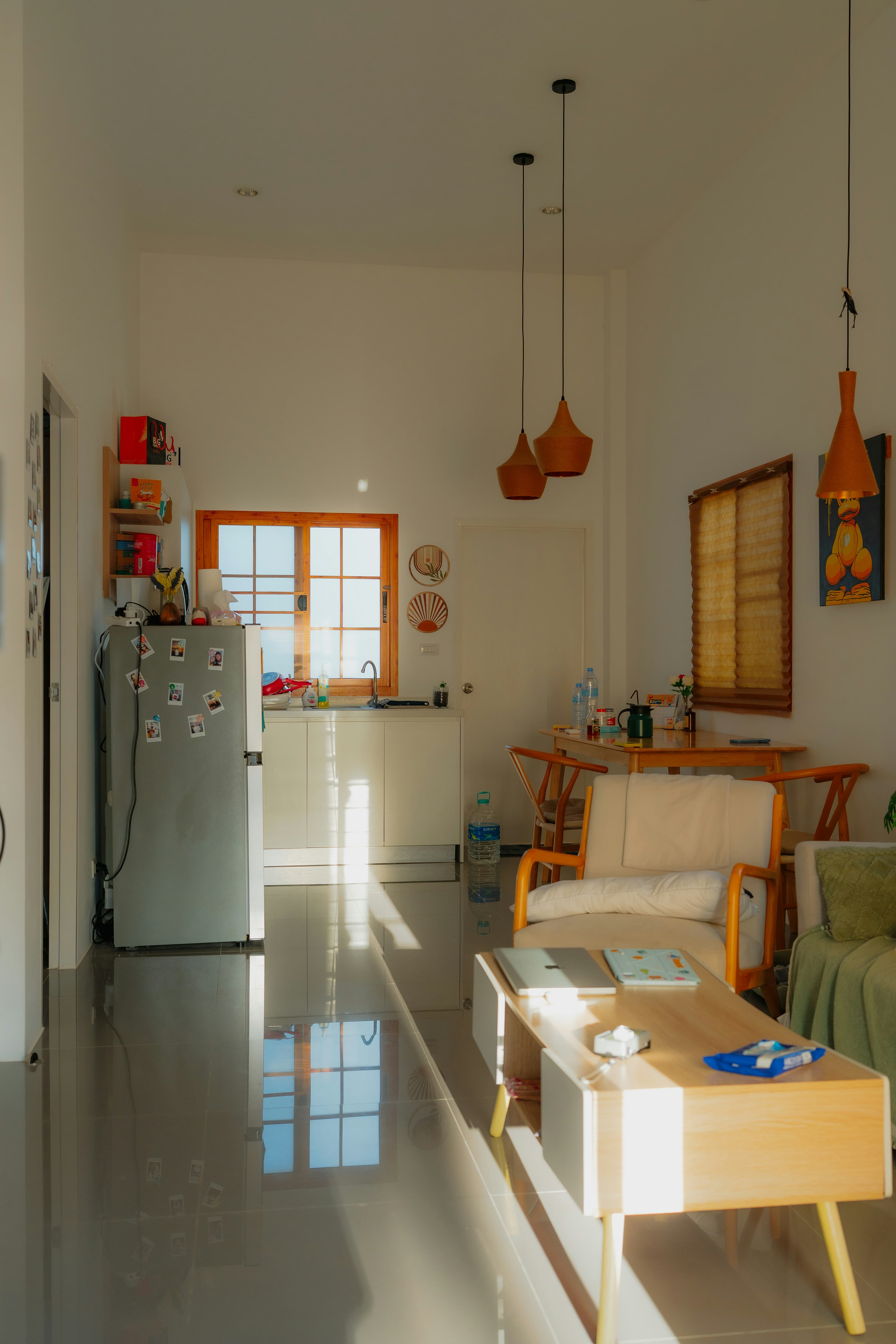
Condo Living
High ceilings, open-plan kitchen and living space, tiled floors and natural light — typical of a well-kept Thai condo. Comfortable and genuinely liveable, though the floor plan is usually more compact in person than it appears in listing photos.
For most newcomers, this is the right starting point. It removes friction from settling in and gives you time to learn the city before deciding where you really want to be.
For most newcomers, renting a condominium is the easiest way to settle into life in Thailand. Everything is designed for convenience. Modern condominiums typically include 24-hour security, reception staff, key-card access, swimming pools, gyms, parking and professional management. If something breaks, repairs are organised quickly through the landlord or building management.
Many developments sit within walking distance of BTS or MRT stations, making commuting around Bangkok straightforward without needing a vehicle. Restaurants, supermarkets, cafés, shopping centres and convenience stores are often downstairs. For someone arriving for the first time, this removes much of the stress of relocating.
Location
Walking distance to BTS and MRT means less travel time and more freedom without a car.
Security
CCTV, key-card access and 24-hour guards give many residents — especially those living alone — genuine peace of mind.
Facilities
Swimming pools, gyms and co-working lounges are included in many buildings, removing the need for expensive memberships.
Maintenance
Repairs are typically handled by building management. Air-conditioning faults, plumbing issues and electrical problems are resolved quickly.
Convenience
Restaurants, supermarkets, 7-Elevens and sometimes entire shopping centres are within a few minutes' walk.
Many people love condo living during their first year. Then something changes. One of the most common observations among long-term residents is that a one-bedroom condo eventually starts to feel small — especially if you are working from home. Your living room becomes your office. Your dining table becomes your desk. Your balcony becomes your only outdoor space.
Noise
Neighbours renovating. Furniture being moved overhead. Thin internal walls and unpredictable noise from shared corridors are more common than marketing materials suggest.
Shared facilities
The rooftop pool looks peaceful in photographs. On a weekend afternoon with forty residents, it rarely does. Facilities also decline in quality as buildings age.
Space
The floor plan looks larger online than it feels in person. After a few months, many people discover they miss being able to open a back door and step straight outside.
Disconnect
Many people describe feeling oddly disconnected from the outside world despite living in the middle of one of Asia's busiest cities.
These are not problems in every building — but they are far more common than newcomers expect.
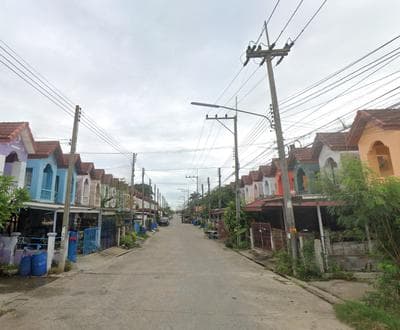
Living in a house offers a completely different experience. Instead of convenience, you are choosing freedom. Instead of shared facilities, you are choosing your own private space. For many long-term residents, this becomes one of the most significant lifestyle upgrades they make.
The first thing most people notice is the extra room. Bedrooms are larger. Living areas feel genuinely open. Many houses include private parking, outdoor seating and gardens. Simple things suddenly become possible: having friends around for a barbecue, drinking coffee outside in the morning, letting children play safely in the garden, owning a dog, growing plants.
Space
Bedrooms are larger, storage is not a problem, and living areas feel genuinely open. The difference in square metres is significant.
Outdoor living
A garden, terrace or private pool changes daily life. Morning coffee outside, evening barbecues, children playing safely — all become ordinary.
Privacy
No shared corridors, no neighbours through the wall, no noise from lifts or lobby areas. You control your own environment.
Pets
Dogs, cats and other animals are far easier to keep in a house with outdoor space than in a condo with building restrictions.
Value
For the same monthly budget, a suburban house often provides two to three times more space than a central condominium.
One of the biggest surprises for many newcomers is price. People naturally assume a house costs significantly more than a condo. That is not always true. A modern one-bedroom condo in central Sukhumvit can easily cost more per month than a three-bedroom house in Bang Na, Nonthaburi, Pathum Thani or other well-connected suburbs.
By moving twenty or thirty minutes further from the city centre, many renters dramatically increase the amount of space they receive for exactly the same monthly budget. With Bangkok's expanding BTS and MRT networks, together with motorcycle taxis and Grab, commuting from these areas is often much easier than people imagine.
Many residents quickly realise they spend less than an hour each day travelling while enjoying a home that is twice the size. The maths often surprises people when they sit down and work it out.
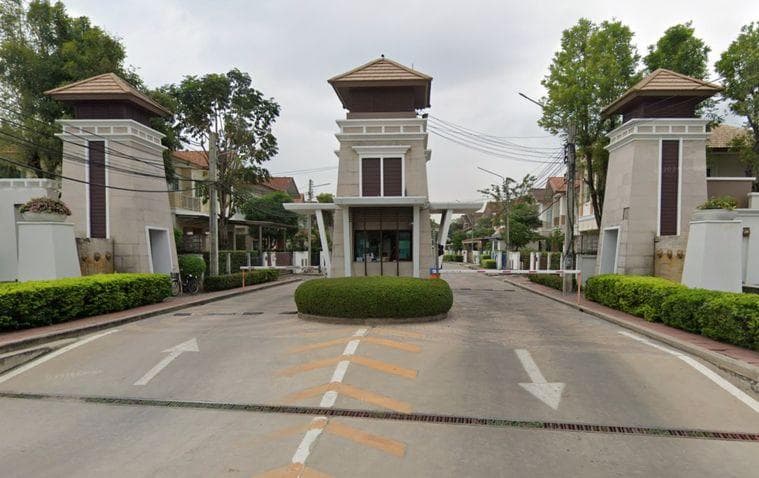
The Suburbs
Bangkok's gated moo baan estates — secure, family-friendly and often significantly cheaper than a central condo of half the size.
Houses are not without trade-offs. You will usually be further from shopping centres, restaurants and public transport. Depending on where you live, owning a car may become more practical — though many residents rely perfectly well on motorcycle taxis and Grab.
Maintenance
Gardens need regular upkeep. Outdoor areas collect leaves. Roofs occasionally leak during Thailand's heavy rainy season, and you may be first in line to sort it.
Pests
Ants, mosquitoes and geckos are part of life in Thailand. Houses naturally experience more of them than high-rise apartments. Pest control is a small, routine cost.
Security
Some housing estates have less controlled access than modern condominium developments. Location and the estate's own management quality matter considerably.
Distance
Nightlife, city-centre dining and spontaneous evenings out require more planning than stepping out of a lift onto Sukhumvit Road.
Remote working has completely changed what people expect from their homes. A one-bedroom condo may feel ideal during the first few months. After spending eight hours every day working in the same room where you relax and sleep, opinions often change quickly.
Houses allow dedicated offices. Separate rooms. Natural light from multiple windows. Outdoor breaks without waiting for a lift. Video calls without hearing neighbours through the walls. If your income depends on working from home, extra space often turns out to be one of the best investments you make when choosing a property in Thailand.
Dedicated office or spare room
No shared walls or corridor noise
Garden breaks without leaving home
Families generally find houses much easier to live in. Children have room to play indoors and outside. Separate bedrooms provide privacy for older children. Storage for prams, sports equipment and everything else that comes with family life is not a constant compromise.
Schools in Bangkok's popular expat areas — Bearing, On Nut, Nonthaburi — are often much more accessible from suburban houses than many people assume before moving.
Pets are an important consideration that many people overlook before signing a lease. Many condominiums either prohibit pets completely or impose strict restrictions on size and breed. Some buildings charge additional deposits, others simply refuse.
Houses provide considerably greater flexibility, particularly when they include enclosed gardens. If you have or plan to get a dog, a house removes a significant layer of complexity from your housing search.
Rent is only one part of the overall picture. The differences between property types are usually modest, but worth understanding before you sign.
| Cost Item | Condo | House |
|---|---|---|
| Electricity | Often landlord rate — can be 2× government rate | Government MEA/PEA rate — significantly cheaper |
| Parking | Sometimes charged separately, ฿1,000–3,000/month | Usually included |
| Internet | Standard market rate — ฿400–700/month | Standard market rate — ฿400–700/month |
| Water | Low — often a few hundred baht | Low — similar or slightly more |
| Garden | Not applicable | Maintenance or gardener — ฿1,000–3,000/month |
| Pest control | Rare — building managed | Occasional — ฿500–1,500/session |
The electricity rate difference can be significant in older condo buildings. Always ask for the actual per-unit rate before signing, not just the estimated monthly bill.
This is your first year in Thailand
You commute into the city centre regularly
You travel often and value a low-maintenance home
You prefer walkable access to restaurants and nightlife
You are living alone or as a couple without children
Security and shared facilities matter to you
You plan to stay in Thailand for several years
You work from home and need space to separate work and life
You have children or are planning a family
You have pets or want to get them
You value privacy and outdoor space over convenience
You want more home for the same or less money
Many long-term residents start in a condo, learn the city, then move to a house. It is a sensible progression. You do not need to make a permanent decision on arrival — just an honest one about where you are right now.
The THAIBK View
A central condo gives you everything you think you want when you first arrive. Close to transport, restaurants, shopping centres and the energy of Bangkok. For the first few months, it is difficult to imagine wanting anything else.
Over time, the priorities of most long-term residents shift. Walking straight outside instead of waiting for a lift. Sitting in fresh air with a morning coffee. Having friends over for a barbecue. Being able to hear silence in the evening.
Moving to a house changes that. Yes, it means living a little further from the centre — but reaching Bangkok by motorcycle taxi and BTS takes twenty to thirty minutes and quickly stops feeling like a trade-off when the home itself becomes somewhere you genuinely enjoy being.
That said, a house is not the right answer for everyone. If you thrive on city life, travel often, or simply want the convenience of having everything within walking distance, a condo can be exactly the right base.
“Your home isn't just somewhere to sleep. It's where you'll build your new life in Thailand. Choose the lifestyle that suits you — not simply the property that looks best in the photos.”
— THAIBK
Independent, verified advice for Thailand expats.
Tell us what you need and we will personally match you with the right property professional in Thailand — whether you are renting, buying or investing.
One-to-one housing and relocation advice. We can walk through area comparisons, budget planning and property type suitability for your specific situation.
THAIBK · SOLA™+
SOLA can compare Bangkok neighbourhoods, commute times and rental budgets in real time — ask it anything about finding the right place to live.